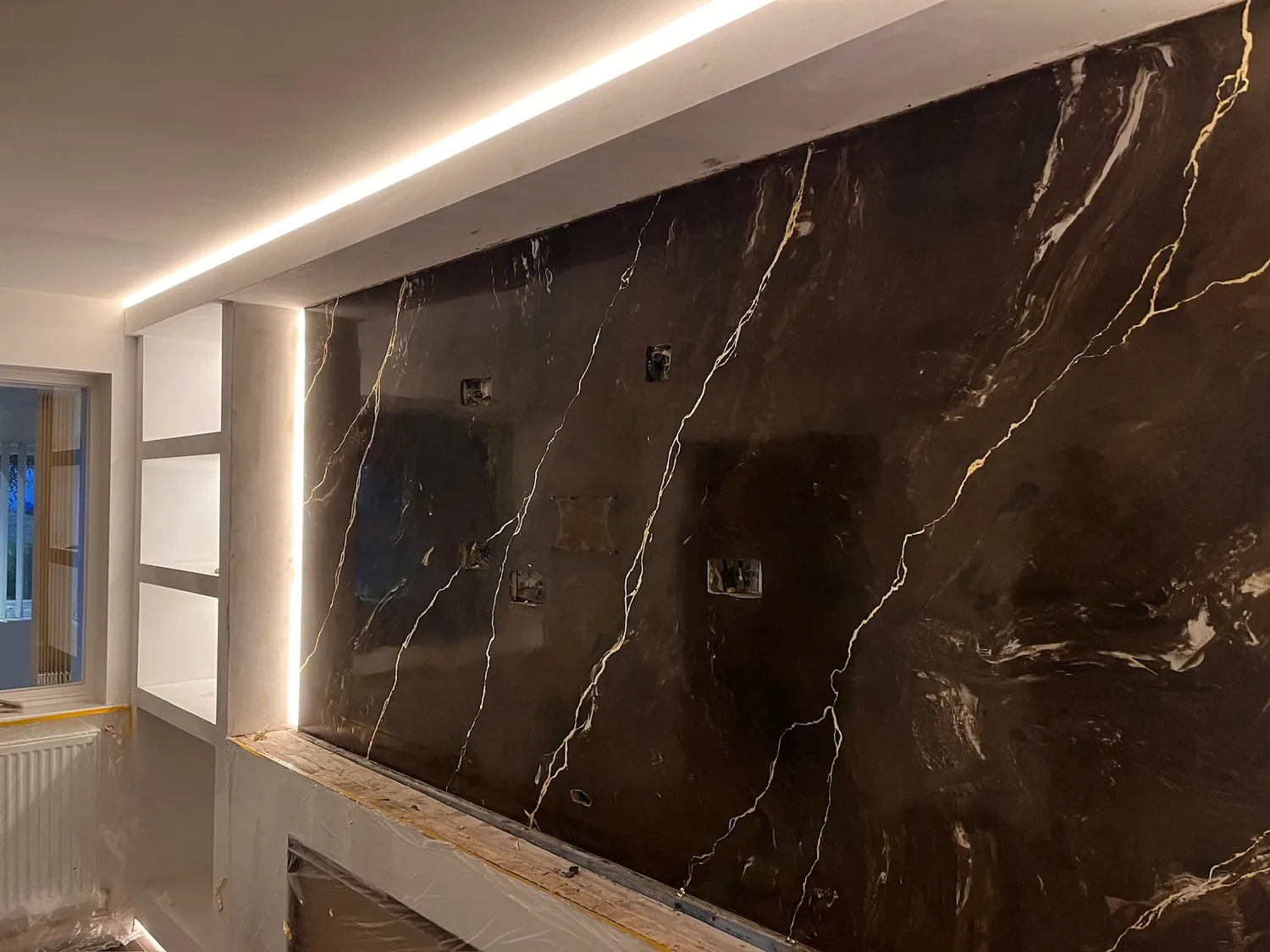
Italian lime by hand, burnished by trowel, nothing sprayed. Architect-specified. Trusted on commercial and heritage work.
No skimming, no general plastering, no subcontracting. Every wall is applied and burnished by hand by people who do it every day.
Supplied by Zavorè, who import it from Italy. We know exactly what is in the tub, and we would not use anything else.
We have worked on a Grade II* listed building, which is the highest listing grade there is.
Made for your wall before you commit to anything. You choose the finish in your hand, not from a photograph.
Once it is signed, it does not move.
Five steps, the same every time. You always know what happens next.
On the phone or on site. We check what the wall is made of and what the room has to put up with, and say which finish will cope.
Your finish, your colour, your sheen, on a panel you keep and look at for a few days. Nothing moves forward until you say so.
Preparation, materials, labour and protection, each on its own line. Nothing buried in a day rate. Signed, it stays signed.
Floors, joinery and furniture covered first. Dust kept down. Coats built and burnished to match the board. The site is cleaned every evening, not just the last one.
A walk round for snags, a note on looking after it, and a surface that gets harder and better with age. We answer the phone afterwards.
Marble dust and aged lime, burnished to a mirror. The finish most people picture when they say Venetian plaster.
A coarser marble aggregate, left matt or taken to a low sheen. More forgiving across a large wall, and it ages better.
Seamless, waterproof and thin enough to go over existing tile. Bathrooms, wet rooms and floors.
Moroccan lime, compressed with a stone and sealed with soap. Seamless and water-resistant, which is why it ends up in showers.
The softest of the six. Cloudy, chalky, brushed rather than trowelled. A whole room in limewash reads as calm.
Real metal particles that oxidise and patinate as they age. Bronze, brass, copper, iron.
We work across Southampton and the water around it. The best residential stock is Edwardian, in Highfield, Portswood and Bassett, with larger houses out towards Chilworth and the New Forest, and then the waterside houses along the Hamble and at Hythe, where the briefs are modern and the budgets substantial. The city is a port and a university, with a steady supply of commercial refits.
In the Edwardian houses we work in lime. In the waterside and New Forest houses the brief is polished plaster and microcement, often as part of a complete interior scheme. Near the water a sealed finish copes with the air better than paint, which is one of the reasons it gets asked for.
Everything about how we work — the samples, the fixed price, the six finishes — is on our main Venetian plastering page. This page is about Southampton.
We cover the whole of Southampton and the towns around it. If your address is not listed, ask anyway.
A picture and a measurement is all we need to start. Next steps within a working day.
If you need any help, feel free to get in touch. We are happy to answer anything about finishes, timings or price.
Message on WhatsApp