Venetian Plaster, Birmingham
What they are, the six finishes they can be made in, and how to pick one.
A Venetian plaster wall is built from thin coats of lime, each one trowelled on and compressed into the one below, then burnished. The depth you can see is not printed or painted on — it is the layers themselves, showing through each other.
That is the whole difference from paint. Paint sits on a wall. This becomes the wall. Run your hand across a finished one and it is cool and hard, closer to polished stone than to a decorated surface, because chemically that is roughly what it has turned into.
Lime carbonates as it cures. It goes on as a soft putty and slowly reverts to limestone over months and years, which is why a genuine lime wall gets harder with age instead of tired. Synthetic look-alikes do not do this, and the difference shows within five years.
“Venetian plaster” is a family, not a product. Marmorino, Grassello, Tadelakt, limewash and microcement are all different materials with different looks and different prices. Anyone quoting you for “Venetian plaster” without naming the system has not told you what you are buying.
We work in all six. They are not interchangeable, and choosing the wrong one for a room is the most common and most expensive mistake people make.
Lime and marble dust, trowelled flat and left with a low sheen. The most forgiving of the six and the one most rooms end up in.
Aged lime putty burnished until it reflects. The glassiest finish there is, and the least tolerant of a bad wall underneath.
Moroccan lime, compressed with a stone and sealed with olive-oil soap. Seamless and water-resistant, which is why it ends up in showers.
A thin cement-based coat that goes over what is already there, including tiles. Matte, modern, and the only one of the six that also takes a floor.
The softest of them. Cloudy, chalky, almost no sheen, applied by brush rather than trowel. A whole room in limewash reads as calm rather than decorated.
Real metal particles suspended in a binder, which oxidise and patinate as they age. Bronze, brass, copper, iron.
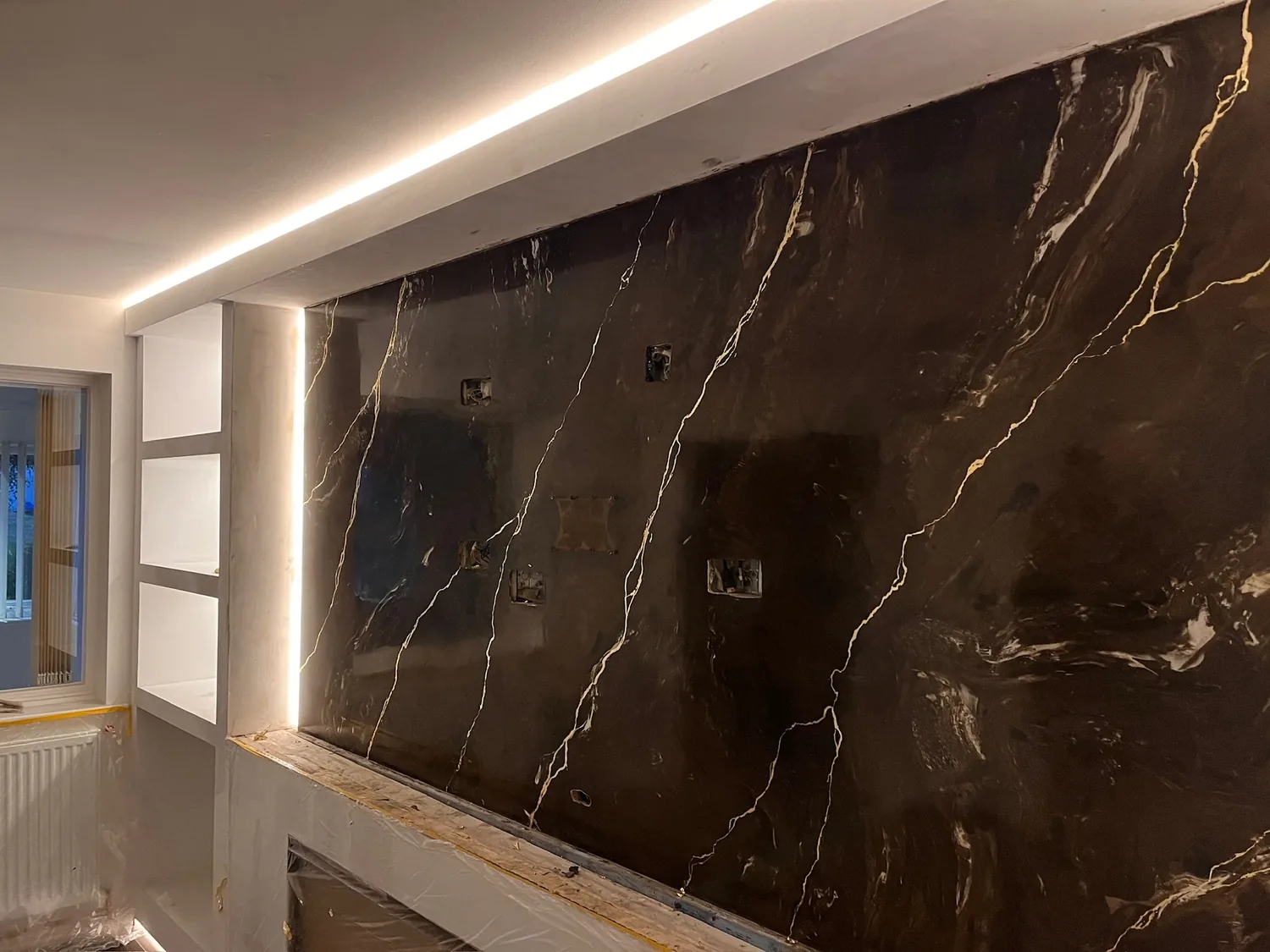
There are two more we use less often — marble effect and concrete effect — both variations on the systems above rather than materials of their own.
A single wall is the usual starting point — behind a bed, a fireplace, a sofa, or the wall you see first walking into a reception. One wall in plaster and the rest in paint is a deliberate look, not a compromise, and it is how most people begin.
A whole room is a different decision. Done in a muted tone it wraps a study, a dining room or a cloakroom in a way a feature wall cannot, and small windowless rooms in particular stop feeling like boxes. Done in a strong colour across four walls it can become a lot to live with, so we will normally push you towards a sample in the actual room before agreeing to it.
Where it genuinely outperforms everything else is on curves. Alcoves, niches, arches, columns, a curved return — plaster is applied wet and follows the shape. There are no joints, no cut lines and no trim, which is exactly where tiles, panels and wallpaper all start to look like a compromise.
Behind a hob, in a shower, or on anything that moves. None of those rule it out, but each one changes the system: a splashback needs a sealer, a shower needs Tadelakt or microcement over proper tanking, and a wall that flexes needs mesh through the base coat before anything decorative goes near it.
More on bathrooms and wet rooms, kitchens and ceilings.
Effectively any colour, because the plaster is pigmented rather than bought ready-made. These ten are our standard range, and any of them can be adjusted lighter or darker.










Two things worth knowing. Deep colours are harder, not easier — black and charcoal show every trowel mark and every repair, so they cost more to do properly. And the colour on a 200mm sample is never quite the colour on a 4-metre wall, which is why nothing is agreed here until you have held a full sample panel in the room it is going in.
A photograph and a rough size is enough to begin. You will have next steps within one working day, and a sample panel made in your finish before anything is agreed.
Costs are the question everyone asks second: what a microcement bathroom costs, per square metre. Materials come from our own supply side, and we work across the whole of the UK from a studio in Birmingham.
If you need any help, feel free to get in touch. We are happy to answer anything about finishes, timings or price.
Message on WhatsApp